
How to use slow feed hay nets for horses

Have you ever wondered if there’s a better way to use slow-feed hay nets? There are so many options, choices, and methods to consider that will keep your nets from being torn, lost, rolled under a fence, drowned in the mud, or buried in the sand!
Different ways of using slow-feed hay nets
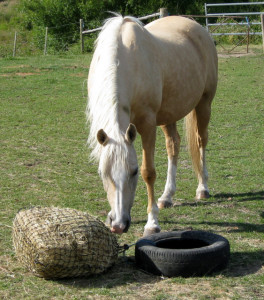
Personally, I like to tie mine to a tyre so they don’t get rolled through manure, under a fence, or into the mud! This works well for barefoot horses on track systems and in small areas where the fences are close together.
If you have a large ‘flat-ish’ paddock or pasture then leaving them loose so the horses can move as they graze can work better than having them tied to something, especially once they have got the hang of eating from the nets.
Not only does it imitate a more natural feeding process but it also spreads seeds around the paddocks.

Some like to tie their net to a tree or a fence, to eliminate the chance of a hoof or a shoe getting caught in the net – this is fine if the fence is solid and the net can’t get tossed over or rolled under, and if you don’t mind the area around the tree being compacted.

Tying or clipping the net into a feeder of some sort will keep the hay dry and collect the seeds/small pieces as they fall out.
This is better for sandy, dusty, or muddy areas and keeps the hay away from manure too. It is also the only way to feed at ground level for horses wearing shoes.
More considerations

Apart from saving hay and stopping it from getting blown away, trampled, or pooped on, slow feed hay nets are aptly named because they do actually slow down consumption, giving the horse more chewing time without increasing the ration. This is the best way to avoid gut ulcers and boredom, particularly if they are confined.
However, some horses and especially ponies still see eating as their full-time job, and until the net is empty they hardly move.
One of the challenges with using nets is keeping our equines moving, so it’s a good idea to use several smaller nets (than one large one), that are placed as far apart from each other and the water source, as possible.
I’m keenly waiting for someone to come up with a robotic platform (like the lawn mowing robots) that you can attach your net to, and will slowly move around the pasture causing the horse to move along as if it were grazing. Now there’s an idea for a budding inventor!
Issues to be aware of
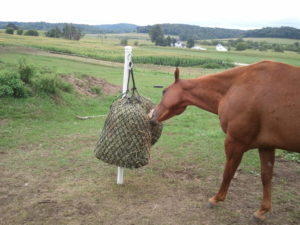
If your horses are tearing up your nets then it may be because they are finding a hanging position too frustrating to be able to grasp the hay easily to start with.
When they are experienced net users, they will cope better, but to start with having the net low on the ground enables them to perfect their ‘nibble’.
Hanging a net from a tree or a pole makes it harder to grasp the hay, so it’s a good solution for greedy feeders as the upright position, and greater movement will slow them down a little.
And if you are feeding a herd of horses together, remember to always have an extra net so the lowest ranking member doesn’t miss out due to the only free net being next to their biggest rival!
If your horses wear shoes or rugs/blankets, ensure the nets are at a height that they can’t rub on or paw at them. Another option is to contain them inside a bin with sides at least 1 metre (3 feet) high.
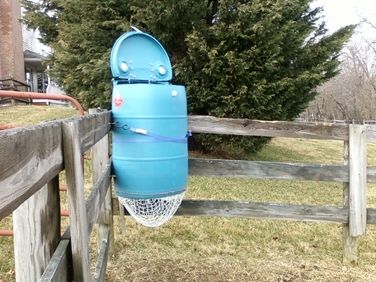
Hard-sided hay feeders such as barrels or bins that have a netted section the hay falls into can be easier for us to fill. They may shelter the hay from rain but can be difficult for the horses to eat at an angle that is healthy for their bodies.
Think about how they naturally graze – biting down on the grass, or tearing off the tops of plants when browsing. Try to mimic that situation for their long-term biomechanical health.
Using nets efficiently
Using hay nets is always going to be more time-consuming than tossing hay out loose, but there are ways to make the filling and distribution faster and more efficient.
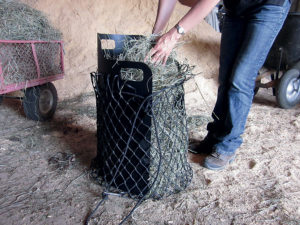
If you have extra nets on hand, filling enough for a couple of feed times can help, especially in winter when there are fewer daylight hours.
Filling smaller nets can also be done quicker by using a ring or tub to hold the net open, or a Duratech Hay Net Filler. It fits the Haysaver Small Nets and Greedy Steed medium and large size nets and makes slipping the hay in so easy. They are also great for filling sacks of manure or shavings.
Round Bale Nets

The most efficient of all methods is using Round bale Haysaver nets.
The upside is less frequent replacement of bales, and the hay is always available – much better for the gut.
The downside is they may not reduce hay intake enough for very greedy ponies, and they encourage a lot of standing around the bale, which can cause a lack of movement.
The more horses, the more movement there will be as they swap places or all head off for a drink.
It’s also important to ensure you have enough round bales for all herd members to get access – generally, a maximum of 4 horses per bale is fine if they all get along fairly well.
I always remove the outer layer of hay, using the soiled bits for mulch and the rest for making piles for those who might miss out on being at the net. This also helps the horses to get used to a round bale net initially, as they have something to fill up on before tackling the netted hay.
Protection from wet weather

Another consideration with using round bale nets is that if you only have 1 or 2 horses eating from the bale, it will take longer to finish and the weather can spoil the bale unless it’s sheltered somehow.
The bottom of the bale can also spoil if contacting the ground so sitting it on a pallet helps.
My Pinterest Page on HayFeeders offers a range of ideas for round bale enclosures and covers, along with other hay feeder options.
For more info and techniques on slow feeding for horses visit our page and other posts on the topic.
And if you have a different way of using slow-feed hay nets, I’d love to hear about it in the comments below.